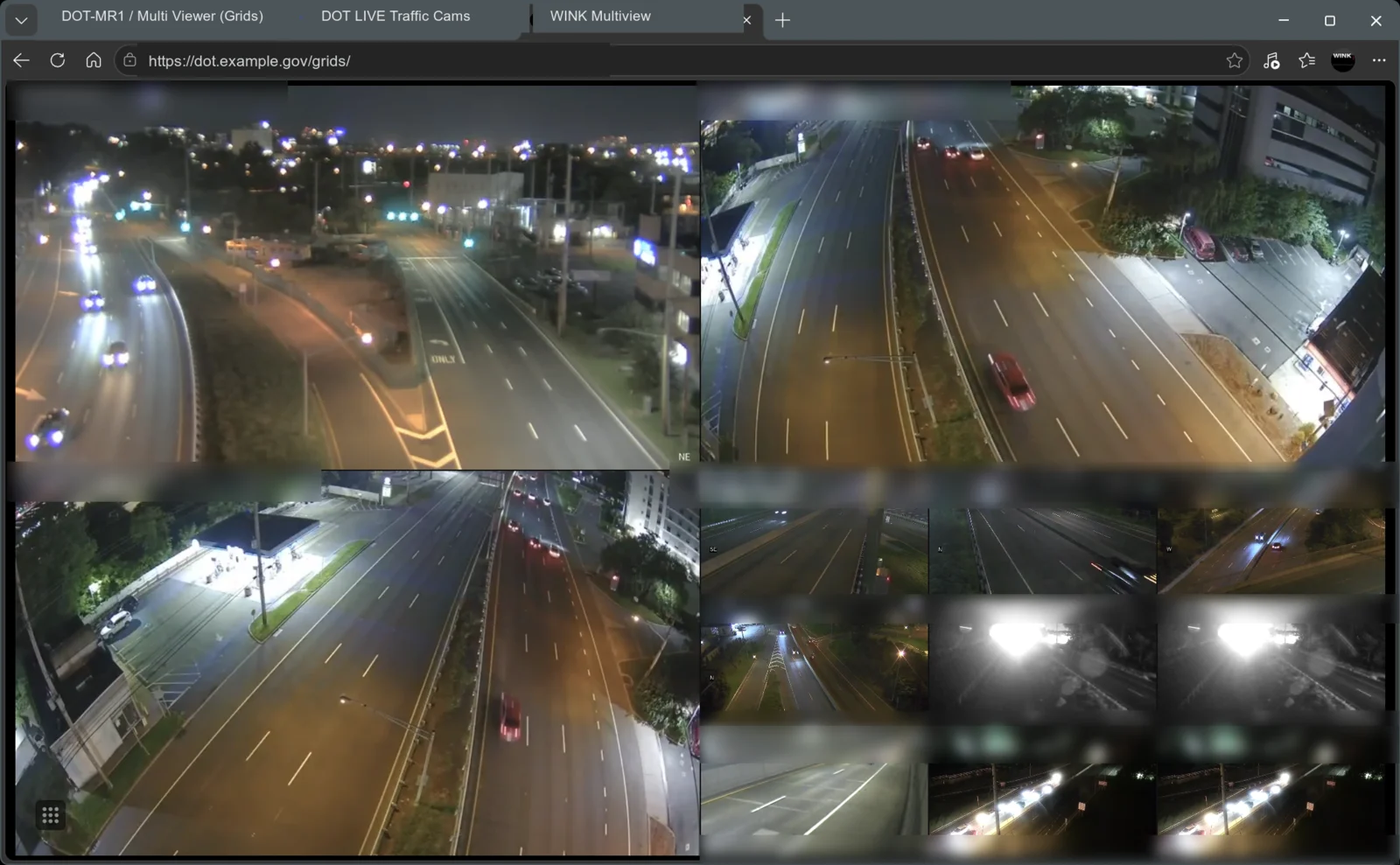
Give TSA, CBP, airport police, airlines and ground handlers live access to exactly the cameras they are entitled to, from wherever they work, without an account on your VMS and without touching the recording chain.
Schedule DemoAn airport is unusual among secure sites. The cameras belong to one operator, but the people who need to watch them work for different employers, answer to different authorities, and turn over constantly. A federal screening supervisor, a customs officer, an airline duty manager and a ramp safety lead can all have a legitimate claim on the same checkpoint camera on the same morning, and none of them should end up with a login to the system that holds your recorded evidence.
The usual answers do not survive contact with that. Handing out VMS accounts means provisioning and deprovisioning staff you do not employ. Exporting clips after the fact is too slow for anything operational. Standing up a second camera network for partners doubles the plant and halves the budget for maintaining either one. What airports actually need is a way to publish a subset of the live estate to a named group, revoke it the moment the arrangement ends, and leave the recording chain entirely alone.
Access is granted per group, per camera. The table below is the shape most airport deployments settle into, not a fixed product configuration. Every line of it is something you set.
| Group | Typically Granted | Typically Not |
|---|---|---|
| Federal screening | Checkpoint lanes, queue approach, divestiture and recomposure | Airside, ramp, tenant spaces, landside roadway |
| Customs and border | Arrivals hall, primary and secondary inspection, jet bridge approach for international stands | Domestic concourses, employee screening, parking |
| Airport police and operations | The full estate, including perimeter and service roads | Nothing withheld |
| Airlines and ground handlers | Their own gates, their own baggage make-up, the stands they are working that day | Any other carrier's gates or baggage areas |
| City or county EOC | Landside roadway, terminal frontage, perimeter during an activation | Sterile area, anything behind screening |
Grants are time-bounded where it makes sense. A handler working a seasonal contract can be given the stands for the length of the contract and nothing after it.
Each group gets a page, not an application to install. It opens in a browser on an operations desk, a laptop in a mobile command post, or a phone on the ramp, and it shows only that group's cameras. There is no client software to push to an organization whose devices you do not manage.
Layouts are saved per group, so a duty manager who arranges six gate cameras the way they like finds them that way at the next shift. Nothing about that view reaches back into the recording system.
Genetec, Milestone, Avigilon and others. On Genetec, Security Center already holds the stream and sends us a copy, so the camera is never pulled twice and nothing has to be opened inbound for that path. On any other VMS, or going direct to cameras, we connect over RTSP on a network path your team scopes and controls.
Airports grow by concourse, and the camera plant grows with them. A 2009 analog head on an encoder in an older pier and a current IP camera on a new stand both arrive as streams and both appear in the same view.
Fence lines, service gates, fuel farms and remote stands often sit on wireless or cellular links with real packet loss. WINK Forge publishes in H.264 by default for exactly this reason, because it degrades gracefully where H.265 falls apart.
We distribute live video. Retention, evidence handling and export stay inside the VMS you already run, under the policies you already have. Nothing we add changes where the recording lives or who can reach it.
A video management system assumes the viewer is on the airport network, at a workstation, with a client installed. Almost nobody on the list of organisations that want your cameras fits that description. An airline's operations centre is in another state. A federal supervisor works from an office that is not yours to provision. An emergency manager during an activation is at the county EOC, not airside.
Removing that assumption is the point. Access is a browser session that works from wherever the viewer actually is, and the path is whatever your security team will approve: the public internet with per session authentication, a VPN between you and a partner, a private circuit for a standing arrangement, or different answers for different groups. A carrier's head office and a police vehicle on the field do not have to arrive the same way.
Airports with satellite facilities, remote lots, cargo areas and a separate general aviation field are effectively multi-site operations. One place to manage who sees what across all of it beats a console per building.
Pushing client software to an organisation whose endpoints you do not manage is a project nobody funds. A link and a credential is a conversation that finishes the same week.
Access is a property of the group, not of the individual. When a handler loses the contract or a federal detail rotates, you change the grant once rather than chasing accounts belonging to people who were never your employees.
No partner is provisioned into the platform that holds your evidence, and there is no parallel camera network to fund and maintain. The recurring security review question, what exactly did we give them, has a short answer you can show on a screen.
Bring the camera count, the VMS, and the list of organizations that keep asking for access. A demo runs against your own feeds.
Schedule Demo