Bridge the recorder in every store to one central site. Loss prevention sees any location in seconds, without a site visit, a phone call, or replacing a single thing in a back office.
Schedule DemoA chain with two hundred locations does not have one video system. It has two hundred of them. Each store has a recorder in a back office, installed by whoever had the contract that year, on a model that was current when the store opened. Some are on the fourth generation of the same vendor, some came with an acquisition, and a few are old enough that nobody still employed remembers who installed them.
The loss prevention team sits at head office and can reach none of it without phoning a store manager and asking them to go and look. Investigating an incident means a site visit or a USB stick in the post. Comparing two stores means comparing two phone calls. The cameras are not the problem and were never the problem. The problem is that the video stops at the back office door.
We do not ask a chain to replace two hundred recorders. We bridge them. Whatever each store runs becomes a stream we can carry, and the central site gets one view across the estate with a viewer that is actually pleasant to use.
Today: ring the store, hope somebody is free, ask them to find it, wait. With the estate bridged: open store 112 from your own desk, look, and decide whether it is worth escalating. The whole loop is minutes instead of days.
Organised retail crime is a pattern problem, and patterns only appear when you can look across locations. Being able to pull up four stores in one view is the difference between four unrelated incident reports and one case.
The classic retail failure is discovering during an investigation that the camera over the till has been offline for five weeks. Estate-wide stream health turns that into a maintenance ticket in week one.
Retail estates change constantly. A new site is added to the central view when it opens, and a closed one is removed, without re-architecting anything or waiting on a project.
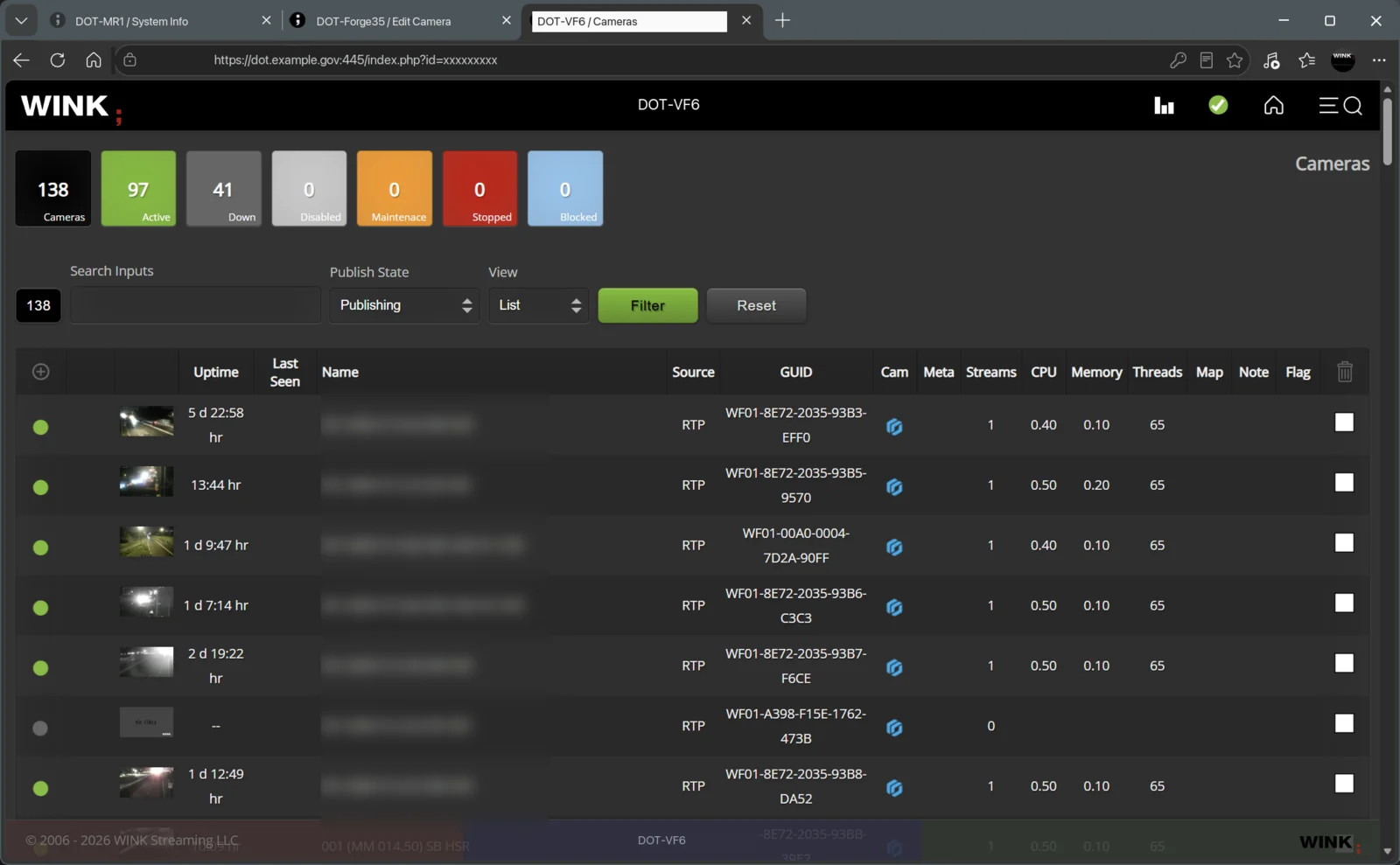
The first thing most chains get from this is not a new capability, it is an inventory. One figure for how many cameras exist across every location and how many of them are publishing right now, regardless of what is recording in each back office.
That number is almost always a surprise. An estate assembled store by store over fifteen years carries more dead cameras than anyone expects, and the usual way of finding out is during an investigation, when it is far too late to do anything about it.
Every recorder in every back office was built on the same assumption: that whoever needs the video is standing in that building, at that machine. For a single shop that is reasonable. For a chain it is the entire problem, and it is why head office has no practical way to see anything without asking somebody local to go and look.
We take that limit away. Viewing is a browser session from wherever the person is, and the connection is whatever suits you: the public internet with per session authentication, the corporate VPN that already links stores to head office, a private circuit, or different answers at different sites. An estate where half the locations arrived through an acquisition does not have to be put on one network design first.
Standardising a chain on one platform is a multi-year capital project that competes with refits and new stores for the same money. This is not that. Each site keeps what it has and the central view is assembled above it.
An analog DVR behind an encoder at a store fitted out in 2011 and a current IP camera at the new flagship both arrive as streams. Whoever is watching does not need to know, or care, which is which.
A district manager sees their district. A store manager sees their own store and nothing else. Loss prevention sees the estate. Nobody is handed an account on a recorder, and a departure or a transfer is one change in one place.
A browser on a laptop in head office, or a phone in a car park between sites. No client software pushed to store PCs you would rather nobody touched, and no VPN client on a district manager's personal device unless that is what your policy wants.
The public internet with per session authentication, the corporate VPN that already links stores to head office, or a private circuit. Different stores can use different answers, which matters when half the estate arrived through an acquisition.
Retail broadband is shared with tills, stock systems and card processing, and video must not get in their way. WINK Forge publishes H.264 at a bitrate you set per site, and holds together on connections that are busy rather than fast.
Related
Bring the store count, what is recording in the back offices, and how long it currently takes to see an incident. A demo runs against your own feeds.
Schedule Demo