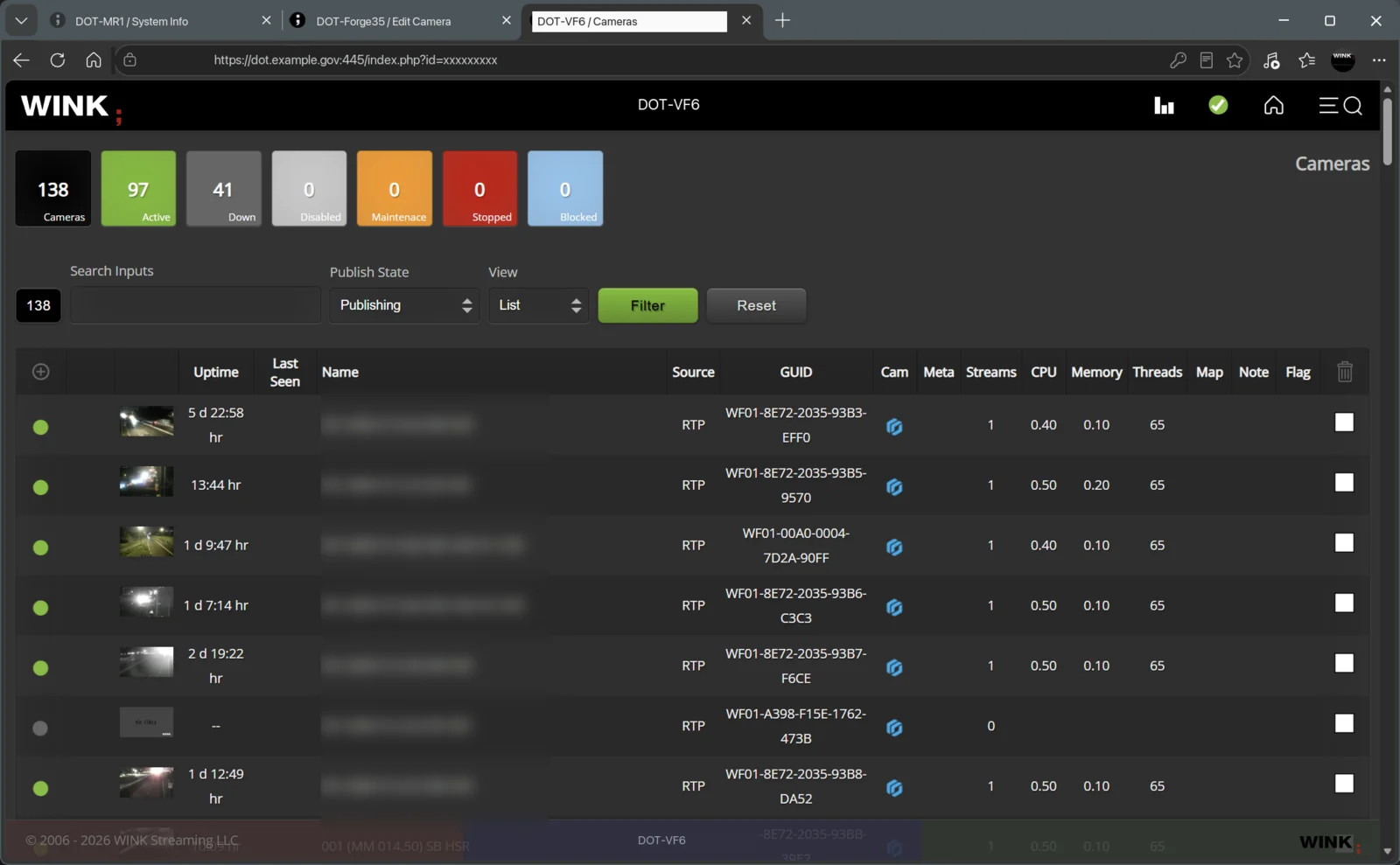
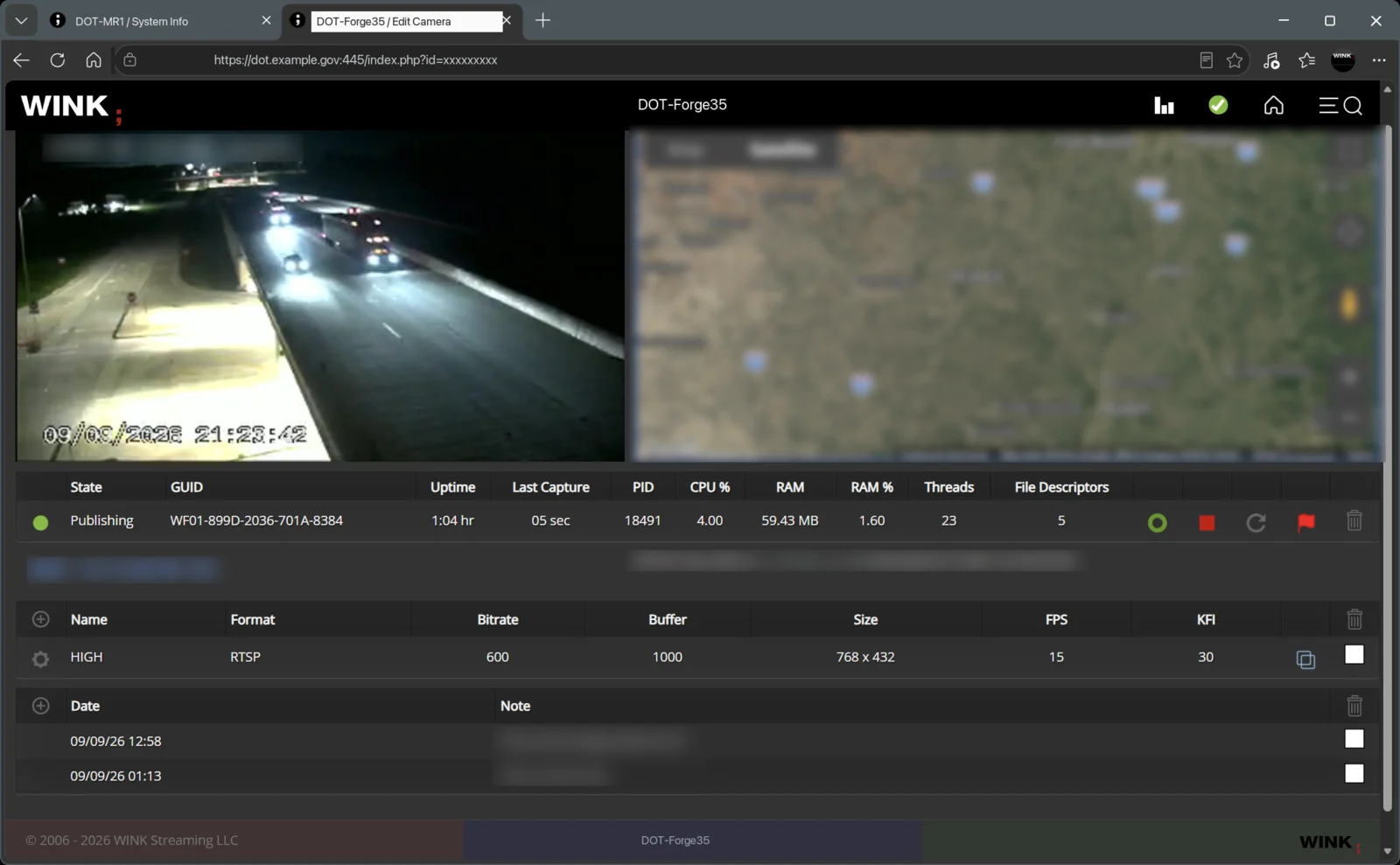
Forge is an enterprise transcoding platform. It runs hundreds of concurrent processes on a single deployment, detects and accepts whatever your cameras happen to produce, and emits whatever the downstream systems require. Mixed vendors, mixed generations, mixed codecs, one predictable output.
A transcoding platform sized for estates where nothing matches: hundreds of streams at once, dozens of camera models, and every codec generation still in service somewhere on the network.
A real camera estate is an archaeology of procurement cycles. There are H.264 cameras bought last year, H.265 cameras somebody specified because it sounded better, MJPEG units that have been on a pole since before anyone remembers, MPEG-4 legacy encoders feeding an old DVR, and a handful of WebRTC and WebM sources from something newer. They arrive over RTSP, RTMP, SRT, HLS, multicast UDP, and plain HTTP.
Forge takes all of it. Incoming codecs are detected automatically rather than declared in a config file, and the output side is equally open: HLS and LL-HLS for the public, DASH and WebRTC for browsers, RTSP and RTMP and SRT for systems that expect them, multi-bitrate ladders where adaptive delivery matters. Downstream, every consumer sees one consistent stream format instead of forty vendor interpretations of the standards.
Scale is the other half. A single deployment carries hundreds of concurrent transcode processes, with hardware acceleration where the platform provides it, which is what makes statewide camera counts affordable rather than theoretical. Where inputs arrive over cellular or wireless links, the same engine reconstructs through packet loss and buffers per input, so one bad link does not degrade the healthy ones.
It runs where the deployment needs it: in AWS or Azure, on our 900PS hardware, as a virtual appliance under VMware, Hyper-V, or KVM, or split with transcoding on premise and distribution in the cloud. Integration with Genetec Security Center is through the native SDK rather than a plugin wrapper, which is what makes camera metadata, PTZ, authentication, and alarms behave the way Security Center operators expect.
H.264 across all profiles including High 4:4:4, H.265 in Main, Main10 and 4:4:4, VP8 and VP9 from WebRTC and WebM sources, MJPEG from legacy cameras, MPEG-4 Part 2 in Simple and Advanced Simple, and MPEG-2 from older DVR systems. Incoming codecs are detected automatically rather than declared.
HLS and LL-HLS for public delivery, MPEG-DASH and WebRTC for browsers, RTSP and RTMP and SRT for systems that expect them, multicast for internal distribution, and multi-bitrate ladders where adaptive playback matters. One input can feed several output formats at once.
A single deployment carries hundreds of simultaneous transcodes, with hardware acceleration where the platform provides it. Density is what turns a statewide camera count from a budget problem into a sizing exercise.
Forty camera models means forty interpretations of the standards. Forge resolves them into consistent output, so players, video walls, VMS platforms, and partner systems all see one predictable stream type rather than a per camera special case.
Packet loss reconstruction recovers usable video where other transcoders macroblock or drop the session, and jitter buffer depth is set per input rather than globally, so a camera on a cellular modem does not cost latency on the ones sitting on fiber.
The measurements in our free command line tools run inside Forge with a web interface on top: packet loss, jitter, clock drift, keyframe alignment, and codec identification, continuously rather than on demand.
Three views: the format matrix, what happens to an impaired input, and where the transcode belongs in a deployment.
1U and 2U rackmount servers with enterprise components, redundant power supplies, and RAID storage, shipped with firmware pre-installed and tuned.
VMware vSphere, Hyper-V, and KVM or QEMU, with OVF and OVA templates. Docker containers and Kubernetes orchestration where the platform is already containerized.
Optimized AMIs on AWS EC2, Azure marketplace images, and Google Cloud, with auto-scaling for workloads that are not flat.
Transcode on premise where the cameras are, distribute from the cloud where the audience is. The most common shape in DOT and public portal work.
VRRP with matching router IDs and a shared virtual IP, network bonding, and MTU tuning for deployments that cannot take a single point of failure.
Input Manager for ingestion and format detection, transcoding engine, output manager driving several destinations at once, a RESTful API gateway, and a browser based admin interface.
A true SDK integration rather than a plugin sitting beside the system. For government deployments this is usually the deciding difference, because it is what preserves the behavior operators already rely on.
Forge bridges platforms that were never meant to talk to each other: Genetec to Milestone through the SDK and an RTSP output, Milestone to Genetec through the universal driver, a legacy DVR into a modern VMS, or a cloud VMS presented back on premise.
It can also emulate a camera outright, so any source appears native to the receiving system: ONVIF Profile S, Axis VAPIX, Panasonic, and Sony VISCA for PTZ. Milestone XProtect, OnSSI Ocularis, Axis Camera Station, direct ONVIF, and direct RTSP, RTMP, and SRT are all supported inputs.
Build several outputs from one input, for example 640x360 at 800 Kbps baseline, 1280x720 at 2500 Kbps main, and 1920x1080 at 5000 Kbps high, with keyframe intervals aligned across variants so switching is clean.
Deinterlacing for older cameras and broadcast sources with yadif and its double rate variant, selectable scaling algorithms, cropping, and image enhancement, chosen against the CPU cost each one carries.
Image watermarks, text overlays, and configurable timestamp formats burned into the output, which is what evidentiary workflows and public feeds usually need before anything leaves the building.
Pan, tilt, and zoom commands survive the transcode rather than stopping at it, so operators keep control of the camera through whatever system they are actually using.
AAC and MP3 encoding, audio filters, and channel mapping, including the cases where the source carries more channels than the destination should receive.
A real time dashboard with per stream status, per stream metrics with exportable statistics, configurable alerts with several delivery methods, and a RESTful API for start, stop, restart, block, and input management.
| Performance | |
|---|---|
| Resolution | Up to 8K, optimized encoding |
| Density | Hundreds of concurrent processes |
| Latency | Under 1s on RTSP and SRT, under 500ms on WebRTC |
| Deployment | Cloud, appliance, virtual, or hybrid |
| Protocols In |
|---|
| RTSP and RTP |
| RTMP |
| SRT |
| HLS |
| UDP and multicast |
| ONVIF for discovery and control |
| Protocols Out |
|---|
| HLS, including LL-HLS |
| MPEG-DASH |
| WebRTC |
| RTMP |
| RTSP |
| SRT |
| Multi-bitrate ABR |
| Codecs In | |
|---|---|
| H.264 / AVC | All profiles, including High 4:4:4 |
| H.265 / HEVC | Main, Main10, Main 4:4:4 |
| VP8 and VP9 | WebRTC and WebM sources |
| MJPEG | Legacy cameras |
| MPEG-4 Part 2 | Simple and Advanced Simple profiles |
| MPEG-2 | Broadcast and older DVR systems |
| Detection | Automatic on every input |
Accepting everything on the way in does not mean emitting everything on the way out. For field deployments H.264 remains the recommended output: at the bitrates security and traffic cameras run, H.265 buys very little compression while giving up error resilience and universal decode support. Read why.
Where a downstream system genuinely requires something else, Forge will produce it. The point of the platform is that the choice is yours per output rather than dictated by whatever the camera happened to ship with.
The distribution half of the core platform. Router takes Forge output and delivers it to agencies, partners, portals, and the public with per session authentication.
The cloud management layer. Crossroad shows the state of every Forge appliance in the field alongside the video those appliances are producing.
An add-on to Media Router for motion detection, object tracking, and people counting on streams already flowing through the platform.
Vehicle detection, plate reading, wrong way alerts, and incident detection for DOT and law enforcement deployments.
Recording and retrieval, with storage tiering that steps quality down as footage ages instead of deleting it outright.
Buy cameras for fifteen years and you do not have a camera estate, you have a sediment. H.264 units from the last refresh, H.265 because somebody specified it, MJPEG on poles nobody wants to climb, MPEG-4 feeding a DVR that still works, and something newer publishing VP9. They arrive over RTSP, RTMP, SRT, HLS, multicast, and plain HTTP, and every consumer downstream wants something different again.
The hard problem in this environment is not encoding efficiency. It is that a video wall, a partner VMS, a public HLS portal, a browser using WebRTC, and a mobile app each need a different format, and no camera produces more than one. Without a transcoding layer the answer is a per consumer special case, which is how estates end up with parallel encoders and nobody able to say which stream is authoritative.
Forge collapses that into one operation. Codecs are detected on the input rather than declared, and the output manager drives several destinations from a single decode: an adaptive ladder for the public, RTSP for the VMS, SRT for the production feed. Deinterlacing, scaling, watermarking, timestamps, and PTZ passthrough happen in the same pass.
Hundreds of concurrent processes on one deployment, with hardware acceleration where the platform offers it, is the difference between transcoding a pilot and transcoding a state. The same engine also has to survive impaired inputs, so packet loss reconstruction and per input jitter buffering are part of the transcode rather than a separate product.
Four hundred cameras, six manufacturers, four codec generations, two VMS platforms that do not speak to each other. Forge ingests all of it, bridges Genetec to Milestone through the SDK, emulates an ONVIF or Axis camera where the receiving system expects one, and publishes a single normalized HLS ladder to Media Router for the public portal. Operators keep PTZ. Nobody replaces a camera to make the integration work.
More detail: the WINK Forge Manual covers the codec matrix, filters, and workflows, the Enterprise Transcoding whitepaper covers the architecture, and Why H.264 Is Almost Always The Answer covers output codec selection.

Tell us what your cameras are connected to and we will tell you what it takes to transcode them reliably.
+1-312-281-5433 sales@wink.co
Contact Sales