Corrections and Detention Video

Central monitoring for every facility you operate, from one screen, wherever that screen is. Your cameras and recorders stay where they are, and so does your evidence chain.

Schedule Demo

Two Problems That Get Confused For One

Corrections agencies tend to describe their video situation as a single problem. It is almost always two, and they pull in opposite directions. Conflating them is why so many procurements stall.

Problem one

Watching a lot of facilities at once

A central or regional office needs live eyes across facilities that were built decades apart, connected by links that were never sized for video. The question is operational and continuous: what is happening now, and is anything down.

This wants throughput, tolerance of bad links, and a view that does not care which generation of equipment is behind each camera.

Problem two

Getting recorded video out, correctly

Counsel, a court, an oversight body, an inspector general or a records request needs specific footage by a specific date. The question is narrow, retrospective, and carries consequences if it is answered late or sloppily.

This wants provenance, a defensible record of who handled what, and no dependency on one person who happens to know the system.

We address the first directly and make the second cleaner by leaving it alone. Live distribution runs alongside your recording platform rather than through it, so nothing we do sits between a court order and the evidence that answers it.

Knowing What Is Down Before Someone Asks

In an estate spread over many sites, cameras fail quietly. A head goes dark on a Tuesday and nobody notices until footage is requested for a Tuesday incident, which is the worst possible moment to find out.

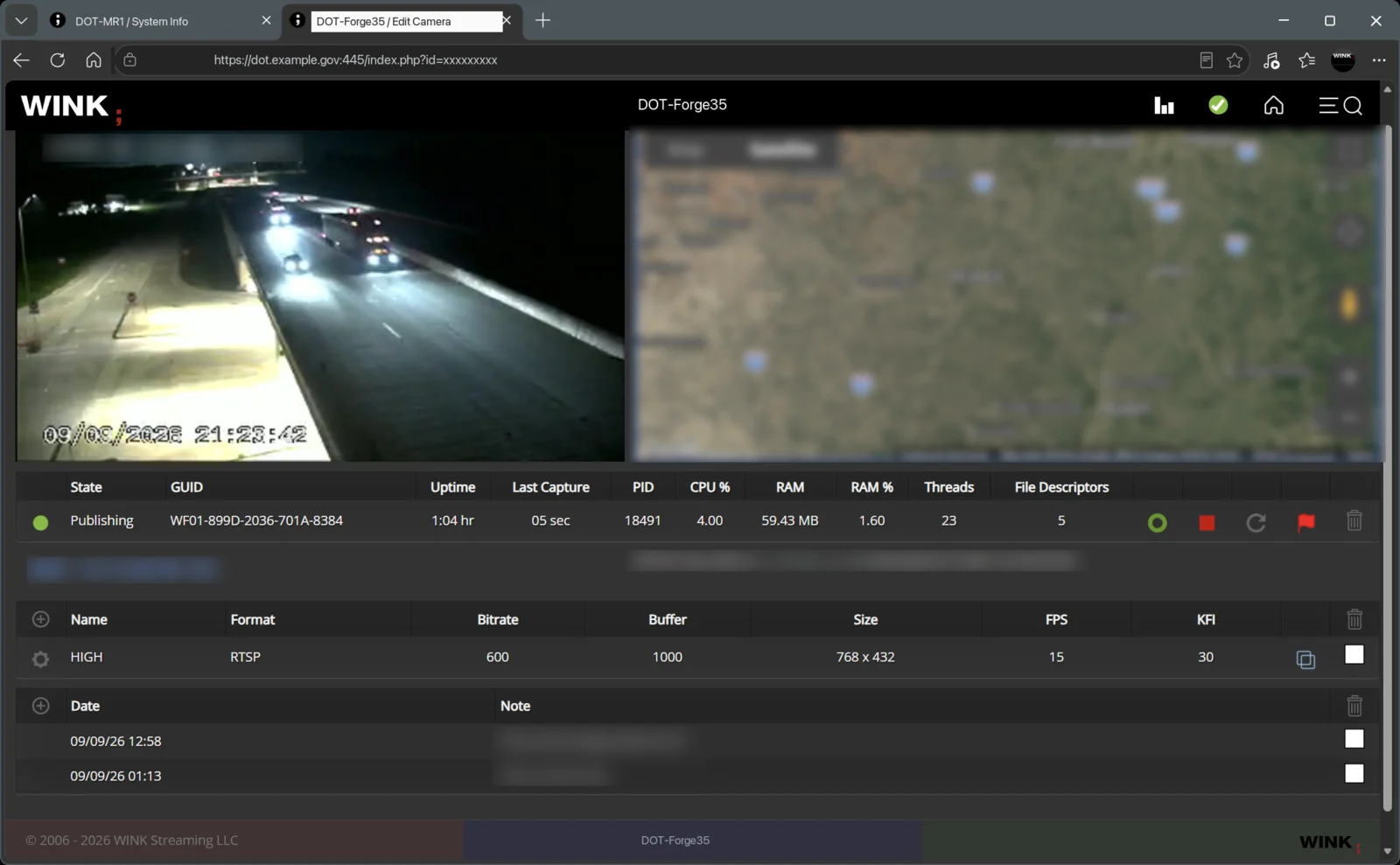
Every stream carries its own state: uptime, last capture, bitrate, the encoder process behind it. A camera that stops publishing is visible as a count on a dashboard rather than as a discovery during a records request.

WINK Forge camera detail view showing publishing state, uptime, last capture, stream format and a dated note log
WINK Forge per-camera detail: publishing state, uptime, last capture, stream parameters and a dated note log. The deployment shown is a roadway estate; identifying fields are redacted.

The Plant You Actually Have

Analog that is not going anywhere

Housing units and corridors are frequently still on analog heads behind encoders, and replacing them means working inside a secure perimeter on a schedule set by operations rather than by IT. Encoder output is a stream like any other to us. The camera stays where it is.

Links that were sized for email

Rural and older facilities often sit on connections that cannot carry a modern video load. WINK Forge publishes H.264 by default and holds up under the packet loss these links produce, where H.265 at the same bitrate breaks visibly.

However the video leaves the facility

Any mix across the estate. On Genetec, Security Center already has the stream and hands us a copy, so the camera is not pulled a second time and that path needs nothing opened inbound. Where a facility runs a different VMS or we go straight to the cameras, the connection is RTSP over a route your network team defines.

Recording stays yours

Retention schedules, evidence handling and export remain in the recording platform and under the policies already written against it. We add a live distribution layer and no second copy of the archive.

A VMS Expects You to Be in the Building

Almost every video management system was designed around a workstation inside the perimeter, on the facility LAN, with a client installed on it. That assumption is why watching another facility usually means driving to it, and why a supervisor responsible for six sites can only ever see one of them at a time.

We take that limit away. Viewing happens in a browser, from wherever the person actually is, and the transport is whatever your security team is willing to sign off on. Over the public internet with per session authentication, inside a VPN you already run, across a private circuit between facilities, or a mix of all three across different sites. The platform does not care which one a given facility uses, so you are not forced into a single network answer for an estate that was never built to one standard.

In practice that means a regional supervisor opens every facility they are responsible for from one screen at the regional office. A duty officer covering nights sees the sites that have nobody awake in them. An investigator reviewing an incident does it from their own desk rather than booking a trip.
Many Facilities, One Control Room

Several corrections facilities converging into one regional control room, with analytics alerts on a separate rail FACILITIES Main facility Genetec Older site Other VMS Annex Analog Work camp Analog Transfer centre RTSP direct normalised to one stream type One regional control room covers every facility above, from anywhere ALERT RAIL Fight or assault Person down Crowd forming Self-harm indicator points an officer at one feed Alerts direct a person. The officer looks and decides; the system does not. Recording, retention and evidence stay inside each facility's own platform.
Facilities converge into one control room that can sit anywhere. Analytics run beside the streams and raise alerts, which is attention-direction rather than judgement.

Staffing Is the Budget

Corrections budgets are dominated by posts, and posts are dominated by overtime. Video does not replace officers, but centralising who can see what changes how many fixed posts an estate has to fund and how far a supervisor's attention reaches.

One control room can cover several facilities

A small facility that cannot justify a staffed control room around the clock does not need one if a larger site's control room can see it. The cameras stay where they are; the watching moves. That is the difference between funding a post at every location and funding one that covers a group of them.

Supervisors stop spending the day driving

Travel between facilities is paid time that produces nothing. A supervisor who can look at any site in their region from where they are keeps that time, and the sites get looked at more often rather than less.

Overtime for coverage, not for presence

A large share of corrections overtime exists to put a body somewhere a camera already points. Where policy allows the watching to be remote, the same coverage costs a fraction of a post, and the overtime that remains is for the work that genuinely needs a person on the floor.

Recruitment is the constraint, not the budget line

Most agencies are not short of posts on paper, they are short of people to fill them. Extending the reach of the officers you do have is usually the only lever available in the short term, and it is the one video actually moves.

What is possible here is set by your post orders and your state's staffing rules, not by the platform. We are describing where the capability exists, not advising on what a facility is permitted to leave unstaffed.

Analytics That Point an Officer at a Screen

Nobody watches ninety camera feeds. Attention is the scarce resource in a control room, and the value of analytics in a corrections setting is not autonomous judgement, it is directing a human being to the one feed that needs them right now. WINK Analytics runs alongside the distribution layer and raises alerts against the streams already flowing through it.

Fight and assault detection

Sudden grouping with rapid, high-energy motion in a dayroom, yard or corridor. The alert goes up in seconds rather than when somebody happens to look, which is the difference between a response and a report.

Person down

A person on the floor, or motionless where motion is expected, held long enough to rule out ordinary behaviour. Medical emergencies in unobserved areas are where delay does the most damage.

Crowd formation

An unusual number of people gathering in a place or at a time that does not fit the normal pattern of the unit. Often the earliest visible sign that something is building, while there is still time to interrupt it.

Self-harm indicators

Behavioural patterns associated with elevated risk, such as prolonged stillness in an unusual position or location, or occupancy of an area outside the normal rhythm of the housing unit.

Every one of these is an alert for a person to act on, not a finding. The system flags a feed and tells an officer why; the officer looks and decides. Self-harm indicators in particular are behavioural cues that something warrants a human check, and they are not a clinical assessment, a prediction, or a substitute for the observation policy your facility already runs under.

Thresholds are tuned per camera, because a dayroom at recreation and a corridor at lockdown have nothing in common. The goal is a small number of alerts an officer trusts rather than a large number they learn to dismiss.

Granting Access Without Giving Away the System

Outside parties, scoped

A monitoring contractor, a medical or mental health provider working a unit, a partner agency during a transport or an incident: each gets a named group with a defined camera list, not an account on the platform holding your recordings.

Revocation that is one action

Arrangements in corrections end abruptly. A grant is removed in one place and the view goes dark, with no credential left in circulation and nothing to chase across systems afterwards.

Talk to Us About Your Facilities

Bring the site count, what each facility runs, and which links you already know are marginal. A demo runs against your own feeds.

Schedule Demo